So Newsnight stated this evening. A remarkable figure, certainly, but a surprising one? Islam and France are not compatible, insofar as a vanishingly small percentage of Muslims entertain the concept of secularism. No Muslim who rejects secularism is anything other than an existential threat to France, and to the French way of life.
Showing posts with label France. Show all posts
Showing posts with label France. Show all posts
Wednesday, 25 February 2015


Saturday, 17 January 2015
How large is the Islamist Fifth Column?
Nigel Farage may have been chastised for employing the term ‘fifth
column’ in a recent Channel 4 News interview when referring to what he termed a
‘tiny minority’ of Muslims in the UK, but his usage of this term was correct:
there is a fanatical and violent Islamist fifth column in this country.
Moreover, it self-evidently exists in many other European countries, wherever
in fact, there are significant Muslim populations, i.e. in every western
European state (although for the sake of exactitude I ought to make clear for
pedantry’s sake that we should probably exclude Andorra, Liechtenstein, Monaco
and San Marino from consideration. As for the Vatican, well . . .).
 How might a ‘fifth column’ be defined? What should we
consider to be its composite elements, and which pose the greatest danger? At
the heart of this fifth column lie violent Islamists. Their numbers are
difficult to estimate, but as a starting point, one can take the number who
have been involved in the conflict in Iraq and Syria on behalf of ISIS or other
Islamist organisations such as Al-Nusra. Intelligence estimates place this at
somewhere in the region of 600. A certain proportion of these are unlikely to
return from the Middle East, but it is reckoned that several hundred have come
back to the UK. These individuals, together with other violent Islamists working
on their own domestic plots who have not travelled to Iraq or Syria, could
therefore number in the high hundreds or low thousands.

Before proceeding further, this piece rests upon the premise
that Islamists actively identify against their European host societies, as the
latter are not, and do not wish to become, Islamic states under the rule of
Shariah. Islamists wish to establish the rule of Shariah and can be divided
into two types: violent and non-violent. The former are willing to employ
terror and revolutionary methods, whereas the latter may be content to use
democratic mechanisms, relying upon gradual demographic change to gradually
take control of the jurisdictions in which they reside. Both are a threat, with
the first group demanding the immediate attention of our security services so
as to contain and neutralise any imminent and nascent plots, whereas the second
group can be dealt with via a combination of long-term surveillance, the
choking off of financial support, and political measures that remove the
ideological ‘respect’ accorded to Islam as a religion in this country and the
other states of Europe.
Not all Muslims are Islamists of course, but all Islamists
believe in Islam. Hence, the higher the resident Muslim population, the greater
the potential internal threat. So, how large is the Muslim population? What is
the trajectory that it is set upon?
The 2011 census recorded a total Muslim population of 2,706,066 in England and Wales, although this of course would not have included
either those people who live here illegally, or those whose command of English
is so limited as to have rendered them incapable of completing the census
return. It is probably safe to assume that the actual number is above 3
million.
The official statistics show that the Muslim population experienced
phenomenal growth between the censuses of 2001 and 2011, for in the first of
these years only 1.5 million people in England and Wales self-reported as
Muslim. When we turn to the demographic composition of the resident Muslim
population compared to people identifying themselves as Christian or as possessing
no religion, the differences are pronounced, and suggest that the problems with
Islamism that we encounter today are likely to grow and intensify in the future.
Even if all immigration from Muslim countries were to cease now, the resident
Muslim population would continue its rapid growth both in terms of absolute numbers
and as a proportion of the overall population.
Whereas 26% of Christians and 39% of non-believers were aged
between 0 and 24 in 2011, 48% of Muslims fell into this age bracket. In the
next age bracket of 25-49, the corresponding figures were a little more evenly
balanced at 31%, 42% and 40% respectively, but turning to the retired segment
of the population aged 65 and above, the respective figures are radically
different, being 22%, 6% and 4%. In age terms alone, the potential for Muslim
fertility is thus considerably greater than for either of the other two groups.
Moreover, Muslims traditionally have larger families than members of the other
groups. It is also worth considering that 53% of Muslims in the 2011 census had
been born abroad, although that said, many second and third generation Muslims
resident in the UK have turned to Jihadism. Islam therefore remains a
physically, as well as a culturally, alien presence in England and Wales, and
the sense of ‘grievance’ that is so frequently voiced by its adherents, from whichever
of its many different varieties, is intrinsically linked to the desire for
power, both cultural and political, in a country in which their culture and
values, which they believe to be innately ‘superior’, have to take a
subordinate position – for now – to those of the host society.
The next element of the fifth column are the sympathisers of
the violent Islamists who, although not willing to endanger their own lives,
may be willing to aid and abet them in their deeds. This group is likely to be
considerably larger, numbering at least in the low thousands. This brings us to
the third element, the political Islamists, who could be divided into those who
are active members of organisations and supporters of campaigns pursuing an Islamist
agenda, and their passive supporters. The first group will contain many more
individuals than those currently willing to pursue violent means, with the pool
of potential passive supporters being massive, numbering at the very least in
the hundreds of thousands, if not millions.
In October 2014, the Times reported that a Populus poll of
2,000 ‘British’ adults revealed that one in seven had “warm feelings” towards
ISIS, with support being at its highest level amongst the under 25s. If one
were to extrapolate from these figures to the general population, this would
imply that circa 9.2 million adults in our country look upon the Islamist
regime in question favourably. Quite clearly, one would correctly think that
the majority of those who do so are Muslim. The pool of support for Islamism in
the UK is therefore several million strong, including, in all likelihood, the
majority of the practising doctrinaire Muslim population. This is the size of
the potential fifth column.
In France, it would seem that things are even worse, with
their fifth column being larger still. A poll carried out in France in August 2014 reported that 16% of the French population were favourably disposed
towards ISIS. How can this be? Do French non-Muslims really have a favourable
view of ISIS? If this poll is to believe, over 10 million French citizens
possess such views, far higher than the generally accepted figure of 4.7
million for the number of Muslims in France.
I can appreciate that many readers will think that I and
others who share my concerns regarding this issue will believe me to be unduly ‘alarmist’,
even ‘paranoid’, but committed minorities can, and do, bend the societies in
which they live to fit their agendas. Depressingly, the tipping point seems to
set in once the committed minority reaches 10% of a given population as one piece of recent research would appear to demonstrate:
‘Scientists at Rensselaer Polytechnic Institute have found that when just 10 percent of the population holds an unshakable belief, their belief will always be adopted by the majority of the society.’
‘Scientists at Rensselaer Polytechnic Institute have found that when just 10 percent of the population holds an unshakable belief, their belief will always be adopted by the majority of the society.’
In France, the UK and Germany, we are not that far away from
such a tipping point with our Muslim populations. This is why the warnings of
Pegida need to be heeded, and the Front National must make headway in France
before it is too late (although of late Marine Le Pen has been criticised for
being too accommodating to Islam. One prominent FN MEP – Aymeric Chauprade –
has released a video in which he declares that France is now at war with some
Muslims, but “not Muslims in general.” The video and an accompanying article
can be found at the Galliwatch blog). What will we do in the UK? Who wants to
return to the Middle Ages? Not me.
Saturday, 26 January 2013
Front National encouraged by Ipsos poll on French attitudes
According to an article appearing in today’s Le Monde,
Marine Le Pen is in buoyant mood following the publication of an Ispsos poll of
French public opinion in yesterday’s edition of the paper. Why? Well, in Le
Pen’s own words, it shows that “the French think like us”. Specifically, it
would appear that Front National attitudes and policies with respect to
immigration, Islam, globalisation and economic protectionism strike a strong
chord with the French electorate.
Overall, the French public is not in an ebullient mood, with
the poll suggesting the prevalence of a distinctly pessimistic worldview. That
this should be so ought to come as no surprise, for France, like the UK, does
not currently find itself in a happy situation either economically or socially.
The pie charts reproduced below provide a striking summary of the twin mood of
economic and cultural decline that appears to have taken root: 55% of
respondents thought that French economic power “has declined a great deal” and
a further 35% believe that it “has declined a little”, with only 7% thinking
that the economy “has progressed a little”. In the cultural sphere, the mood
remains negative, but not in quite so pronounced a fashion as with respect to
the economy: 23% thought that French cultural influence “had declined a lot”
with a further 40% stating “that it had declined a little”.
In factually rather than politically correct fashion, 74% of respondents in the poll subscribed to the notion that Islam was an “intolerant”
religion; 77% stated that “religious fundamentalism” (code for Islam) was a matter of concern to them; 57% were of the opinion that “anti-white racism is
quite common in France”, and 62% “no longer feel at home in France”. Data are
not provided with respect to ethnic and faith differences amongst respondents,
but the results clearly indicate that France is a cleft society, with a
significant proportion of indigenous French citizens feeling a distinct sense
of cultural alienation from their own homeland because of the momentous changes
wrought by mass immigration in recent decades. My sympathies on this score lie
with the French. Whether or not the French have lost Paris as the English (or
indeed, the British) have lost London, I do not know, but similar processes
driven by the twin ideologies of globalism and permeable borders are leading to
a crisis of national self-identity in both countries. However, to express this
sense of alienation from one’s own homeland and the political class who
implement and advocate the policies that lead to this dispossession is to run
the risk in both the UK and France of being branded a ‘far-right extremist’,
which is of course a deeply malicious and wounding slur upon the part of those
who level it.
One commentator – Michel Winock – described by Le Monde as a
“specialist in the history of politics and ideology in modern France” has used
the findings of this poll to make tired and lazy comparisons with France in the
1930s, raising the hoary old spectre of recrudescent ‘fascism’ that is so often
wheeled out by defenders of mass immigration and state-sponsored
multiculturalism on either side of La Manche when confronted by popular
distaste for these two elite-sponsored projects. To equate a desire for
national self-preservation and cultural distinctiveness with ‘fascism’ is
repugnant, but that does not prevent the likes of Winock from seeking to firmly
implant this false association in the public mind with the assistance of a
largely eager and compliant mass media.
In conclusion, the policies forwarded by the Front National
chime strongly with the concerns of native French voters, but thus far the
party has not been able to make a significant electoral breakthrough. What
then, will it take for French voters to give voice to their dissatisfaction by
voting for a party that offers policies that they favour, and for them to
overcome their aversion to voting for Le Pen inculcated by many years of deeply
hostile coverage of the FN?

Wednesday, 19 September 2012
Charlie Hebdo and the Hysteria of Islamists
Once again, the
French satirical magazine Charlie Hebdo has fallen foul of the Islamists by
publishing cartoons of Mohammed, leading to the usual threats and security
alerts that attend any slight to the fragile sensibilities of ‘the devout’.
This is not the first time that it has been targeted, for back in November last
year its decision to publish a special issue entitled Charia Hebdo which
contained many cartoons of its ‘guest editor’ Mohammed, led to its offices
being firebombed. Both incidents highlight a phenomenon first generated by the
Danish Jyllands-Posten furore and its publication of a number of Mohammed
cartoons in 2005.
Charlie Hebdo
published a fresh set of cartoons this week as a response to the violently
febrile reaction to the ‘Innocence of Muslims’ film that has been witnessed
across much of the Muslim world and amongst some Muslims resident in European
states. These reactions serve to illustrate the ugly domineering impulse that
lies at the heart of Islamic doctrine, and it is of course crucial that we
tackle this challenge in an appropriately robust fashion: we must not cave in
to Islamist threats, and their demands to restrict freedom of speech and
expression in our nations; blasphemy is no offence.
In Germany, the
Pro-Deutschland movement has expressed its desire to publicly screen the
‘Innocence of Muslims’, causing some disquiet amongst the German authorities
and sections of the media that have wheeled out the usual demonising ‘racist’
and ‘far-right’ labels to apply to the group. In Russia, Communications
Minister Nikolai Nikiforov called for Google to block Russian web access to the
film’s Youtube site, threatening to curtail its freedom to operate in the
country from November if it failed to do so. Rostelekom, one of Russia’s
biggest internet providers, blocked access to Youtube in a number of Russian
regions last night, and Yaroslav Nilov, Chairman of the Duma Committee on Social
and Religious Organisations, has called upon the Ministry of Culture to ban screenings of the film in Russia on the basis that this would constitute
“incitement to religious hatred.” He noted that Russia had a Muslim population
of 20 million. The reaction of these influential Russian politicians seems to
have been born out of a combination of a desire to appeal to the growing number
of Muslim voters in the country, and of fear.
It is time that
mainstream broadcasters and politicians in Britain and other European nations
stopped pretending that these violent outbursts, threats and intolerance are
not connected to Islamic doctrine, which is incompatible with a modern,
civilised political and social worldview. In our countries, Muslims should not
only be seen to respect our right to freedom of speech and expression and to
acknowledge the supremacy of secular law, but they should also give active
support to these principles. If not, then they should give serious
consideration as to where they ought to live: is it to be here, or somewhere
more conducive to their mental and cultural universe, such as their ancestral
familial homeland(s)? The recent violent reactions to the ‘Innocence of
Muslims’, the Charlie Hebdo cartoons and Tom Holland’s ‘Islam: The Untold Story’,
have followed swiftly upon the anniversary of 9/11, which makes it apparent
that all of these attacks upon freedom of expression are part of a wider
Islamist political agenda.
Given this reality,
how can anyone still give credence to what is printed in the pages of The
Guardian upon such matters? That paper, and the BBC, to name but two
influential players in the mass media, ought to offer us an explanation as to
why they have systematically distorted reporting about Islamic issues so as to
provide Islamic doctrine with a veneer of respectability, helping to embed it
within our country and to facilitate its spread. We never wanted it, and we
certainly do not need it. Now is as good a time as any to make this fact
crystal clear.
Charlie Hebdo's latest cover

Wednesday, 4 July 2012
Maghrebian Monster shames France
Bullying is an exceedingly nasty trait, and it would seem
that for ‘French’ athlete Mahiedine Mekhissi-Benabbad, aggressive bullying is
an intrinsic part of his character, most recently illustrated by his attack
upon a 14-year-old girl dressed as a mascot following his win at Sunday’s
Helsinki 3000m Steeplechase (see video below). Thankfully, the Daily Mail reports that the girl was only winded, but the manner in which he treated her
reveals him to be a damaged character with an anger problem. Such behaviour has occurred before, as shown in the second clip, where at around a minute and 30
seconds into the video he is seen to contemptuously push a mascot into a
kneeling position before him. He also received a 10-month suspension for
attacking a teammate in Monaco in 2011.
What
will happen to this arrogant 'Frenchman' of Algerian descent following
this latest act of ill-tempered aggression? If I were French, I would
not be happy to see this man representing my country and bringing it
into disrepute, and would rather that he ran for Algeria instead. He may
run for France, but he is neither French nor a sportsman. Kick him out
of France. He's a liability.
Unsporting Maghrebian masquerading as Frenchman

Mekhissi-Benabbad's spiritual Brother


Mekhissi-Benabbad's spiritual Brother

Wednesday, 20 June 2012
Toulouse Gunman: Schizophrenic or Islamist?
A gunman reported to have taken four hostages in a Toulouse bank today is claiming to be a member of al-qaeda, whereas the local authorities claim that he is suffering from "schizophrenia." The Daily Telegraph reports that three gunshots have been heard, but thankfully there has been no news of injuries or fatalities.
The gunman himself - "Boumaza" - claims that he has taken the hostages for "religious" rather than financial reasons, so it can only be hoped that French police manage to bring this situation to a swift and safe conclusion, given the favoured Islamic method of executing hostages. One hostage was released earlier this afternoon. At the time of writing, Boumaza is not reported to have made any specific demands, which perhaps lends credence to the official line that he is suffering from schizophrenia. His sister, who is helping police with negotiations, says that her brother reacted very negatively to being taken into social care as a child, becoming angry with and fearful of the outside world.
UPDATE
According to Lenta.ru, the gunman has been arrested after an exchange of fire during which he was wounded. None of the hostages are said to have been harmed. A video report from the scene can be viewed below.
Police in Toulouse

Monday, 18 June 2012
Le Monde celebrates ‘La Diversité’ in the French National Assembly
Le Monde, one of France’s most influential newspapers of a
centre Left editorial inclination, has today been indulging in the type of
reporting so beloved of the ‘diversity’ industry in the UK, noting with approval the influx of a fresh phalanx of non-indigenous deputies to the
National Assembly:
Essentially ‘white’ until now, the National Assembly is going to reflect the colours of France a little more after the legislative elections of Sunday 17 June. Eight deputies of African, Maghrebian, Asian or Brazilian origin are going to join those elected overseas or originating in the departments on the banks of the Palais-Bourbon. All these newly elected members issue from the ranks of the Socialist Party.
Of these, five are Maghrebian: Kader Arif (Haute-Garonne);
Malik Boutih (Essonne); Kheira Bouziane (Côte-d'Or); Chaynesse Khirouni
(Meurthe-et-Moselle) and Razzy Hammadi (Seine-Saint-Denis), and thus illustrate
the rapidly shifting demographic complexion of France. It is to be expected
that they will lobby for the inclusion of more of their kind, as has happened
at Westminster with the active approval of the globalist governing parties.
The French National Assembly: a little less French Today

Sunday, 17 June 2012
Front National Victory: Marion Maréchal-Le Pen elected
Whilst it seems that a recount is underway in Hénin-Beaumont, Marion Maréchal-Le Pen has been elected as the National Assembly Deputy for the 3rd District of Vauclause, polling 42.09% of the vote. Her losing rivals were the UMP's Jean-Michel Ferrand and the Socialist Catherine Arkilovitch. At 22, she becomes France's youngest ever member of the National Assembly.
Elsewhere, the lawyer Gilbert Collard put in an impressive performance in the 2nd District of le Gard, winning the seat for the Front National with 42.82% of the vote, a healthy increase on the 34.57% that he polled in the first round. His rivals - Katy Guyot of the Socialist Party and Etienne Mourrut of the UMP - took 41.56% and 15.63% respectively.
The most spectacular result for a French nationalist candidate today belongs to ex-Front National member Jacques Bompard who has won in the 4th District of le Vauclause, taking 58.77% of the vote, well ahead of his Socialist rival Pierre Meffre on 41.23%. Bompard has his own identitarian party named the Ligue du Sud, its name seemingly inspired by Italy's Lega Nord (Bompard was initially listed as an FN victor in this article owing to his erroneous allocation to the party by Le Monde's election results page).
Elsewhere, Florian Philippot failed to take the 6th District of la Moselle, but put up a very creditable performance in a close contest, scoring 46.3% against the Socialist rival's 53.7%. Stéphane Ravier had an exceptionally close race with the Socialist Party candidate Sylvie Andrieux in the 3rd District of Bouches-du-Rhône, taking 49.01% against 50.99%. Valerie Laupies also came with a hair's breadth of winning, taking 48.71% of the vote compared to her Socialist rival's 48.71% in the 16th District of Bouches-du-Rhône.
Despite Marine Le Pen's knife-edge loss to her Socialist opponent Philippe Kemel, with the candidates securing 49.89% and 50.11% of the vote respectively, it has been a dramatic evening for the Front National, for it has managed to take two seats under the first-past-the-post system. This is a considerable achievement for the party, although of course it does not take its representation in the National Assembly close to that which it enjoyed in the 1986 election, when it managed to gain 35 deputies under proportional representation.
Marine Le Pen's programme of modernisation has evidently paid off for the FN, but although today's breakthrough has been symbolic, the party is as yet at a far remove from real power. Nonetheless, it has demonstrated the principal that a credible and well-organised moderate nationalist party can win under a first-past-the-post system. If it had not been for the anti-FN pact in Hénin-Beaumont which led to Jean-Luc Mélanchon bowing out of the second round despite qualifying to participate, then Marine Le Pen would have tonight won a seat. The FN has also encountered other types of underhand opposition, as exemplified by the action of postal workers in the Var who refused to deliver flyers for FN candidate Genivieve Blanc. According to the Riviera Times, although 4,000 euros had been paid to distribute the 54,000 flyers, the postmen refused to do so on political grounds, claiming that they would not help a 'far-right' candidate, thereby demonstrating their anti-democratic credentials by impeding the chances of a legitimate candidate.
Three other FN candidates stood in the second round in the urban constituencies of the Pas-de-Calais and polled respectable percentages, each in a one-to-one battle with a victorious Socialist Party opponent. The FN candidates and percentages were: Freddy Baudrin (3rd District) - 40.48%; Monique Lamare (10th District) - 36.59% and Charlotte Soula (12th District) - 43.17%. For a party of this type, these were excellent scores, and illustrate that the FN does possess what it takes to become a party of government, given the clear appeal that it exerts to sections of the French electorate.
Time for the FN to make a significant electoral breakthrough is of course running short owing to France's rapidly changing demography engendered by mass immigration and the explosion in the population of immigrant descent. With this in mind, the FN has recently launched a petition (see here) against granting voting rights to immigrants, which is a policy supported by both the Socialist Party and former President Nicolas Sarkozy.
Marion Maréchal Le Pen

Front National launches Petition
Given that the French elections are currently in the news,
it seemed an appropriate time to take a look at France’s Front National (FN)
which is hoping to gain its first members of the National Assembly under the
first-past-the-post system today. A visit to the party’s main website reveals
that the FN has launched a petition in response to the desire of both the
Socialist Party and Nicolas Sarkozy of the UMP to grant voting rights to
foreigners resident in France. This of course undermines the first principal of
democracy, and the FN has rightly launched its campaign to try and stop this
move dead in its tracks.
Whilst Nicolas Sarkozy is often portrayed, particularly by
the British media, as someone who has flirted with the fringes of policy accorded
the pariah label of ‘far-right’, his quotes in favour of granting foreigners
the vote highlight this for the misleading propaganda that it is. Sarkozy may
have ‘talked tough’ on immigration and immigrant crime, yet he acted very
softly on these issues, for he is a globalist, and as such, no supporter of the
historical rights and interests of the French people. Reproduced below is a
translation of the Front National’s introduction to its petition against the
right of foreigners to vote in French elections (responsibility for any errors
in translation being entirely mine). Although I agree with their cause, not
being French I did not see it fit to sign. However, if you are French, you
would be advised to add your name to the list of supporters. I hope that the FN
succeeds in this endeavour, but fear that it will not.
Petition against Foreigners’ Right to VoteOn the eve of the senatorial elections, the first declaration of Martine Aubry, the First Secretary of the PS [Socialist Party], has been to reaffirm his attachment to the right to vote for foreigners and of making this an absolute priority.This demagogic position does not have to conflict with the UMP since Nicolas Sarkozy has declared: “I wrote in 2001, in my book, that I was favourable towards the right of foreigners voting in municipal elections.” Then again: “I do not find it abnormal that a foreigner in a regular situation, who works, pays taxes and who has lived for at least six months in France, may vote in municipal elections. I am opening a debate in favour of a measure that I think is just.”Totally disconnected from the French people and discredited, the UMP and the PS are searching above all to reconstitute a client electorate at the least cost.While Nicolas Sarkozy and the Socialist Party are favourably disposed towards the right to vote for foreigners, the Front National is resolutely against this for obvious reasons:1) Since the French Revolution, nationality and civil rights have been related. Now, to accord the right to vote to foreigners would make citizens via the backdoor, by providing a right to date reserved for nationals that would be in total contradiction of the republican spirit!2) The argument consistently stated that “since the foreigners pay taxes, they must be able to vote” is totally fallacious. In effect, there is already a return for their taxes, which are the various benefits (school, social security, health and justice. . . )3) The Front National is for the sovereignty of peoples, and recognises the right of all peoples to be able to decide their own destiny, the French the foremost!The recent Tunisian elections are a perfect illustration: if the right to vote for foreigners is granted, the Tunisians settled in France would be able to vote in French elections while they are already participating in elections in their own country. They would thus benefit from a right to vote superior to that of French nationals.4) Whilst French identity is constantly portrayed in a bad light, all that is common to the French is being chipped away little by little, and they are forced to share a right that is common to them which contributes to maintaining a sense of belonging to the French nation!For all of these reasons, the Front National is launching a great national petition to oppose the right to vote for foreigners: http://www.frontnational.com/petition-contre-le-droit-de-vote-des-etrangers/

Front National to take 7 Seats?
The Galliawatch blog reports that the Front National could
stand a chance of taking seven seats in the National Assembly in the second
round of elections in France today. Below are the seven seats in question,
together with the names of the FN candidates and their shares of the vote
garnered in round one of the elections last Sunday:
- 11th district of Pas-de-Calais - Marine Le Pen , 42.36%
- 3rd district of le Vauclause - Marion Maréchal Le Pen, 34.6%
- 2nd district of le Gard - Gilbert Collard, 34.57%
- 3rd district of Bouches-du-Rhône - Stéphane Ravier, 29.87%
- 16th district of les Bouches-du-Rhône - Valérie Laupies, 28.98%
- 6th district of Moselle - Florian Philippot, 26.34%
- 4th district of le Vauclause - Jacques Bompard, 23.51%
Sunday, 10 June 2012
Marine Le Pen wins in Hénin-Beaumont
Reuters have confirmed that Marine Le Pen has won the first round of voting in the town of Hénin-Beaumont by taking 42% of the vote. As she has not won more than 50% there will be a second ballot next Sunday, so victory is not yet in her grasp. Her arch-opponent Jean-Luc Melanchon came third, and has thus announced that he will not be standing next week, recommending instead that his supporters vote for the Socialist candidate Phillipe Kemel. When the Front National looked as if they would win the mayoralty of the town in 2009 by securing 39% in the first round, all other candidates bar one stood down and recommended that their supporters vote in favour of the one remaining opponent. Melanchon's decision to stand aside indicates that this tactic is about to be repeated, but can Le Pen win anyway, for she is after all starting at a higher baseline of support than in the mayoral election? The contest in the town looks set to have a nailbiting finish.
Background on the race, including information on a rather controversial
flyer campaign, can be accessed by clicking here.
UPDATE
Across France as a whole, the Front National took the third largest share of the vote. Marine Le Pen's niece - Marion Le Pen - managed to top the poll with 34% in Vauclause, and thus will also enter next Sunday's runoff. The GalliaWatch blog reports that the Front National has made it into the second round in 61 of the 577 constituencies, rather less than its high watermark of 133 in 1997.
Marion Le Pen - First in Vauclause

Hénin-Beaumont: Le Pen versus Melanchon
Today the first round of the French elections to the
577-member National Assembly will take place, with the second round being held in a
week’s time. Given the economic and political turmoil besetting the Eurozone,
this election will have particular significance for the future tenor of policy
within its constituent states and for the EU more widely.
Hitherto, the Front National has not won a seat in the
National Assembly under the current first-past-the post system (under proportional representation it managed to take 35 seats in 1986), but it is estimated that the party could possibly, rather
than probably, take up to 8 seats on this occasion. It is in the town of Hénin-Beaumont that the most interesting constituency contest looks set to take place, with Marine Le Pen standing against Left Front leader Jean-Luc Melenchon. Across
France the Front National has been scoring between 12 and 18% in opinion polls over the past month, with those from the past week suggesting a level of
support between 14 and 15%. However, in Hénin-Beaumont the popularity of the
Front National is considerably higher, which coupled with Marine Le Pen’s
profile, could result in a win for the party.
Hénin-Beaumont is twinned, rather appropriately given its
closed pits and post-industrial malaise, with Wakefield. Even the light
industry that replaced mining, notes the BBC, is closing down and moving out,
such as in the case of a Samsonite factory which shut five years ago, its
jobs being outsourced to Eastern Europe with half of its workforce
remaining unemployed today. The ‘enormous factory floor is now home to squatters.’
Clearly, this is not a town imbued with a sense of optimism, its economic
plight serving as an indictment of globalist free-market policies. Le Pen’s
approach therefore, ought to possess a strong appeal in the constituency.
Traditionally, Hénin-Beaumont has been a Socialist
stronghold, but in 2009 the Front National secured first place in its mayoral election with 39% of the vote in the first round, but alas, it was defeated in
the second ballot owing to all other candidates standing down and uniting
around a left-wing independent Daniel Duquenne. If Le Pen does not take more
than 50% of the vote today, it is therefore likely that opposing candidates
will once again stand aside and recommend that their supporters unite against
the Front National. However, this in itself should not be a cause of despair for
Le Pen, for Duquenne’s victory in 2009 was secured by a very narrow margin: 52%
to 48%. The most recent test of popularity for the FN in the constituency was
the presidential election, and Le Pen came out on top with 35%. Will she
therefore be able to break the mould of French politics and win a seat? Such a
victory appears to be plausible.
Jean-Luc Melanchon is a visceral opponent of the FN, the
Galliawatch blog noting his recent comment that "Our objective remains to defeat the FN, to eradicate it politically, we will do whatever is necessary until we have the last word." (from an interview published in Direct Matin
June 5, 2012). His bad tempered totalitarian tenor is accompanied by a vigorous
anti-French position as expressed in his recent statement that “There is no
future for France without Arabs and Berbers from the Maghreb.” Quite the
contrary Monsieur Melanchon, I think that you will find that France will
possess no future other than as a mere geographical and historical expression
if the demographic inroads made by these North African peoples continues.
Flyers displaying these two statements have been circulating
in Hénin-Beaumont, but who has produced them is a matter of uncertainty. It has
undoubtedly made the irascible Melanchon furious, but why, given that he has
said these things and presumably believes what he has said, should he be angry?
The flyers after all, are only informing voters of what Melanchon stands for.
One of them, admittedly, is in poor and rather inappropriate taste, featuring a
doctored image of Melanchon set against the backdrop of a concentration camp,
presumably as a retort to the constant unjust accusations of ‘Nazism’ thrown at
the FN (Madonna, the superannuated enfant terrible, apparently made a cheap and inaccurate 'political' point whilst performing in Tel Aviv last week, appearing onstage brandishing an AK47 with a projection of Marine Le Pen with a swastika on her forehead as a backdrop). The other however, is reproduced below and features his quote on Arabs,
Berbers and his de facto support for the end of France. It is only fair that
the voters know what this man believes, and as such, these flyers fulfil a
useful function.

What, if any role, will this negative publicity play
in the campaign? Whatever happens, the contest in this French town in desperate
need of economic regeneration is going to prove to be a very interesting one.
Monday, 23 April 2012
Nicolas Sarkozy isn’t listening
“I have heard you”, Nicolas Sarkozy is said to have told Front National voters today as he made a desperate attempt to win them over in the second round of the French presidential election. Now, like me you may find such a phrase uncannily familiar, for have you ever heard your boss say “I hear what you’re saying” or “I hear you”? If so you know what it means: nothing. It is simply a polite way of disarming your gripe, even though your boss is utterly dismissive of it and disagrees completely with the substance of what you are saying. Hearing after all, is not listening, although this distinction seems to be lost on many people. Don’t believe me? Well, try comparing Sarkozy’s words here as quoted in The Daily Telegraph: “I've heard you...The French don't want to be dispossessed of their way of life. That's the message I heard, and I will take to the second round of the election," with what he says in the video below where he makes it clear that the French people should effectively cease to be.
There is only one good thing about Nicolas Sarkozy: his wife, for it has to be said that Carla Bruni is very easy on the eye. Other than that, there is nothing really to be said in his favour. However, the attractiveness of someone’s wife or otherwise really doesn’t constitute grounds for lending them support or not. Then again, thinking of Tony Blair and . . . brrr! He and his wife were a ‘good’ match come to think of it.
Anyway, returning to more serious matters en France: Marine Le Pen did manage to secure a creditable 17.9% of the vote, although unfortunately this was insufficient to allow her entry to the second round of the contest. That Sarkozy as the incumbent, failed to win the largest share – coming second to François Hollande with 27.18% to 28.63% - was noteworthy, for apparently this is the first time in the past fifty years that this has happened to a presidential incumbent running for re-election. Sarkozy therefore needs the votes cast for Le Pen in the first round, and is making patriotic sounds (debunked by the video linked to above) to try and woo Front National voters. Why though, should they support him?
It is wise that Le Pen has refrained from recommending who her voters should support. Tactically, it would be wiser for her circa 6.4 million voters to abstain, registering their condemnation of both Sarkozy and Hollande. It is almost inevitable that Hollande will harvest the votes cast for other candidates of the Left such as Melenchon, but there is no inevitability about Sarkozy taking votes from the Front National. Hollande looks set to win.
"Less people voted for you than bought my last album Nicolas."

Sunday, 22 April 2012
Le Pen set for more than 20%?
An exit poll published by Harris earlier this evening suggests that Marine Le Pen has come third in the first round of the French presidential election, securing 20.7% of the vote, with Sarkozy taking 27% and François Hollande 28.5%. Although Le Pen appears to have won a significantly higher share than predicted, it may be the case that it could have been higher still if indeed allegations connected to the withholding of Le Pen ballot papers from 16 departments and many voters resident overseas prove to be true. The GalliaWatch blog is sure to post more up-to-date material on this shortly, and the real results will be available soon enough.


The French Presidential Elections: a Muslim Bloc Vote?
In what would appear to be an interesting parallel to the recent behaviour displayed by Muslim voters in Bradford West and their election of George Galloway, Al Jazeera notes that in today’s first round of the presidential election French Muslims are ‘likely to vote for the far left’. It notes:
Throughout the duration of the campaign for France's presidency, one issue has come up over and over again.
Islam, and whether it has a place in French society, has been a favourite issue of the two right wing candidates, the National Front's Marine Le Pen and Nicolas Sarkozyof the Union for a Popular Movement (UMP).
France’s Muslim population is even larger than that of Britain’s both in terms of its overall size and share of the national total, and as has occasionally been documented on the pages of this blog, concern over cultural and demographic Islamisation has been growing in France, wedded as it is to its central national idea of laïcité, an approximate translation of which is secularism. Given the tenets of doctrinaire Islam, the two were bound for inevitable collision, resulting in agonised national debates over the veil, the burqa, minarets, praying in the streets and most recently the unwitting consumption of halal meat, particularly in the Paris area, by ordinary Frenchmen and women. One opponent of Islamisation - Christine Tasin - even received a fatwa demanding her death for her robust secularist stance, so the debate about secularism in France does possess a real implications for the lives of the country's citizens; it is not some petty theoretical debate.
Marine Le Pen has not been backward in articulating popular concerns over the various facets of Islamisation, and although doing reasonably well in the opinion polls, having often scored in the high teens or low twenties, unfortunately does not appear to be on course to participate in the second round of the presidential context. If allegations published on the GalliaWatch blog relating to Le Pen ballots being withheld from 16 departments in France as well as from many voters resident overseas prove to be true, her vote could be considerably lower than anticipated. Instead, it would appear that Sarkozy will go head-to-head with the Socialist Party candidate François Hollande, with the two being almost neck and neck in recent polls. Who wins will very much depend upon where Le Pen’s and Jean-Luc Mélenchon’s (the Left Party candidate) supporters cast their votes in the run-off. The majority of Muslims however, have made it quite that Sarkozy will not secure their support because of his perceived ‘Islamophobic’ attitude and pronouncements (in reality Sarkozy talks tough but does little so as to undermine support for Le Pen). This is very much in line with the presidential elections of 2007, for as The Washington Times observes:
So it therefore seems likely that Muslim voters in France will throw their support behind Moroccan-born Jean-Luc Mélenchon today, and then François Hollande in the second round. George Galloway and Ken Livingstone are but the most notable politicians to have participated in the creation and the exploitation of the Muslim bloc vote in Britain, and it would appear that a parallel process could be underway in France. Could it be that across Europe a pattern is emerging in which Muslims are casting their votes en bloc for particular candidates and parties that specifically pander to their demands? Will this register with the rest of the electorate? The Washington Times notes that it has certainly registered with sociologists:In April 2007, polls found that French Muslims voted mainly for the Socialist presidential candidate: Segolene Royal won 64 percent of their vote, while Mr. Sarkozy got just 1 percent in the first round and 5 percent in the second.
“People who would have originally voted for the center or the right-wing are now determined to vote against Nicolas Sarkozy,” Ms. Lorcerie said.
France’s Muslim community is mobilizing voters to reject President Nicolas Sarkozy in Sunday’s election to punish the conservative leader for his anti-immigrant and anti-Islam rhetoric.
“[French] Muslims can’t stand it anymore. They are fed up with these debates about national identity, halal meat, the veil or fundamentalism all over the place,” said Francoise Lorcerie, a sociologist with the Institute of Studies on the Arab and Muslim World near Marseille.
“The terms [Islam, immigration and fundamentalism] are being used interchangeably, without care, with people being targeted, denigrated and used for [votes].”

Wednesday, 22 February 2012
Bardot for Le Pen
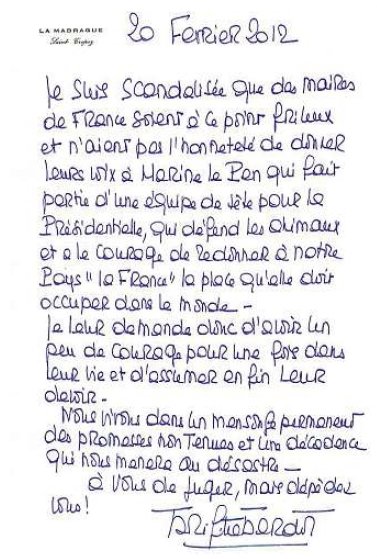
Brigitte Bardot, scourge of Islamisation and halal slaughter, has penned a note in endorsement of French presidential candidate Marine Le Pen, published today in the French regional paper Nice-Matin. In it, she appeals for more local officials to lend their signatures to Le Pen’s nomination papers, for the latter is still short of the 500 required to stand. With only a few weeks to go until the 16th March deadline, there are some 60 signatures to be gathered.
Bardot in her Prime

Bardot herself is of course no stranger to controversy, having been fined on a number of occasions for ‘inciting racial and religious hatred’, but she has stood by her beliefs. Who after all can disagree with her statement in her 1999 “Open Letter to My Lost France” that "my country, France, my homeland, my land is again invaded by an overpopulation of foreigners, especially Muslims" or her condemnation of the Islamisation of France in her 2003 book Un cri dans le silence:
Over the last twenty years, we have given in to a subterranean, dangerous, and uncontrolled infiltration, which not only resists adjusting to our laws and customs but which will, as the years pass, attempt to impose its own.
Bravo for Brigitte! Let’s hope that her letter helps Marine to enter the electoral fray not only for the first round of presidential elections on 22nd April, but the second on 6th May. For more on Marine Le Pen and her presidential campaign, as well as opposition to the Front National in France, click here.
Bardot's Letter
Friday, 9 September 2011
Bloc Identitaire stage “Die in” against anti-white Racism in Dijon
Let us for a moment imagine the following situation: you have travelled to the centre of an attractive provincial city for the afternoon, and whilst you are walking along a pedestrianised street you suddenly see a small group of people. All are dressed similarly, and walk but briefly before calmly assuming prone and supine positions on the street, as if dead; clothing spattered with red, suggesting blood. Their silent forms lie still, bringing to mind the plaster casts of the victims lost to the Vesuvian eruption of AD 79. Another member of the group appears with a megaphone, places signs on their bodies and starts to address the shoppers. What is going on?
The French political group Bloc Identitaire is innovative and unorthodox, as was reflected last Saturday in its novel approach to highlighting the phenomenon of anti-white racism with reference to the specific case of a recent racially motivated murder in Dijon, about which the authorities have chosen to remain silent. A group of activists took their message to the centre of Dijon through employing an eye-catching piece of street theatre – a “Die in” against anti-white racism. This was followed by a leafleting session distributing the flyer shown below entitled ‘Open Season for hunting Whites in Dijon!’
Having watched the video below, consider this: would it have been possible to do something such as this in the UK? Somehow, I suspect that had anyone chosen to highlight anti-white racism in such a fashion here, they’d probably have found themselves promptly arrested and charged with ‘inciting racial hatred’. What follows is a translation of the Burgundy Bloc Identitaire press release and video of the “Die in”.

Tuesday, 6 September 2011
Marine Le Pen on Muslim Street Prayers
Marine Le Pen is of course the Front National’s candidate in the 2012 French presidential elections and is riding high the country’s opinion polls, which suggest that she is likely to be one of the three most popular candidates. Unfortunately, if she does manage to make it through to the second round of voting, it is probable that as in the 2002 presidential election when her father went head-to-head with incumbent President Jacques Chirac that the other parties will unite to call for their supporters to vote for whoever is left standing against her. The likelihood of a Front National victory is thus slim, but nonetheless should not be discounted altogether.
Back in 1998, Guillaume Faye made a number of observations re political opposition to the Front National, noting that it arose from a fear of the party’s genuinely radical alternative. As in the UK, where nationalists of all stripes are routinely and unjustly tarred with the ‘Nazi’ brush, Faye notes that this tactic has been repeatedly used in an effort to baselessly stigmatise the Front. In his opinion, its opponents have sought to:
‘gag and undermine the Front because it seeks to re-establish the moral contract between the people and its leaders. Hence, it is accused of being immoral. But facts will speak for themselves – the politicians and the media will not be able to twist them. So the only path open to the system is not to ban the Front National but abolish the people. It is already trying to do so. Immigration is one of its weapons, but it is a double-edged sword, for the system – and I will stress this once more – is forgetting about an essential player: Islam.’ (Faye, Guillaume (2010/1998), Archeofuturism, Arktos, United Kingdom, p. 142).
Faye’s concern with Islamisation – which he sees as being Europe’s primary existential threat, rooted in the de facto colonisation of the continent – is something that separates him from a number of figures in the Nouvelle Droite - such as Alain de Benoist - from which he sprang. More generally however, Islamisation has emerged as a contentious political problem in France, for doctrinaire Islam’s inability to allow a separation between the secular and the ‘spiritual’ strikes at the very heart of French republican identity with its strict tradition of secularism – laïcité.
As elsewhere across the world and in other European countries in particular, Muslims are becoming emboldened with respect to public displays of religiosity, a symptom of this being their willingness to break the law by holding Friday prayers and blocking streets in cities such as Paris, Nice and Marseilles. This sense of boldness and willingness to disregard the law has been bolstered by the fact that Muslims are now estimated to comprise somewhere in the region of 5-10% of the population; a proportion that has grown rapidly through mass immigration and a birth rate which greatly exceeds that of the native French population. Moreover, the authorities have generally turned a blind eye to this phenomenon, thereby allowing it to become entrenched and grow.
Given the reluctance of the French political establishment to acknowledge let alone deal with the Islamisation problem, Marine Le Pen has decided to take a symbolic stand on Muslim street prayers which she roundly condemns in her video address below. This is sure to strike a chord with a significant section of the native French electorate, but you can be sure that there will be a media storm in which Madame Le Pen is accused of the non-existent phenomenon of ‘Islamophobia’ as well as ‘racism’, and that her opponents will attempt to avoid rational debate because there is no rational debate to be had: Muslims who block the streets with their prayers are breaking the law. Can you imagine a contender for high office voicing such sentiments in the UK? Me neither, which is a pity.
The text below preceding the video is translated from the Bivouac-ID blog as it provides an interesting insight into a French secularist perspective on Le Pen’s speech:
Marine Le Pen’s Speech on Street Prayers
A speech which should certainly be viewed against the backdrop of the forthcoming electoral contest, but where real questions are clearly and courageously posed without evasive political language. Why aren’t the nominees of the other parties able or willing to do as much?
The problem posed by Islam is posed to the whole French nation, and must naturally transcend political rivalries.
Tuesday, 14 September 2010
Eiffel Tower Terror Attack Thwarted?
Today the French Senate ratified the ban on face veils passed by the National Assembly in July. A few hours later at 9pm local time the Eiffel Tower and surrounding area were evacuated following a bomb alert. Some 2,000 people left the Tower itself and a further 25,000 vacated its immediate vicinity. The BBC notes that France has been on a heightened state of alert since 2 August following threats from a Maghrebian branch of al-Qaeda, but for some reason its report makes no reference to the ratification of the veil ban. This is the second time this year that the Eiffel Tower has been associated with an Islamist terror plot, for back in June it was reported that plans for an attack using a helicopter and poison gas had been uncovered. The ban itself, notes the Daily Mail, was passed by a huge majority of 246 votes to one in the Senate. There were however, a small number of abstentions.
Hopefully, should a bomb be present the French police will manage to defuse it and no harm will come to anyone or to this iconic Parisian symbol. Once again the threat of Islamist terror has made itself felt in the non-Muslim world, just a little over a week after a coalition of French secularist groups staged a series of anti-Islamisation protests under the banner of the Grand Apéritif Républicain to commemorate the 140th anniversary of the foundation of the French Third Republic. These demonstrations led to the issuing of a Facebook Fatwa against their organiser Christine Tasin, which soon demonstrated its ugly reality through a number of death threats including one from the utterly inappropriately named black Islamo-French rapper ‘Cortex’.
In France, Germany, Holland, the UK, Denmark, and many other European countries, the presence of the Muslim minority is having a disproportionately influential and negative impact upon the lives and liberties of their respective citizenries. We are however beginning to see the crystallisation of popular resistance to Islamisation and a groping towards its political articulation. This process of native European reassertion is most advanced in Holland, but recent headlines connected to the Thilo Sarrazin affair and the creation of Die Freiheit indicate that a similar dynamic is now at play in Germany. In France, this reassertion possesses a secular guise, but is not as yet as powerfully developed as in the two aforementioned countries. In the UK, none of the mainstream parties will acknowledge the issue let alone class it as a problem, and none of the smaller parties are currently in a fit state to provide a viable platform for popular mobilisation, hence the growth of the EDL.
We must watch closely and observe if France manages to successfully assert its sovereign right to determine how it deals with undesirable immigrants following its censure today by the EU Commission for its recent deportation of parasitic Roma elements. France and the other nations within the EU must reassert their sovereignty and cast off the anti-European stranglehold of Brussels. I am pro-European, but anti-EU. That distinction is important. The Islamisation of France and the rest of Europe can only be defeated if we dismantle the anti-European and anti-democratic superstate called the EU. Only once this is achieved, will our peoples truly be free again.
Subscribe to:
Posts (Atom)